
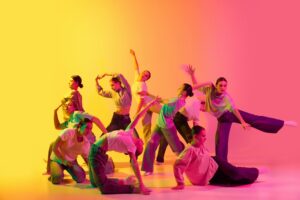
Most people have watched a dance performance and felt something — a pull, a moment of awe, maybe even something they couldn’t quite put into words. What they were responding to wasn’t just the movement. It was the choreography behind it.
But what does that word actually mean? And why does it matter?
At its most basic, choreography is the intentional arrangement of movement. It’s the process of deciding how bodies move through space, how those movements connect to music, and how the whole thing adds up to something an audience can feel.
A choreographer is the person who designs that experience. They’re working with the same raw materials as a composer or a filmmaker — rhythm, tension, contrast, release — but their medium is the human body in motion.
Here’s where a lot of beginners get it wrong: choreography isn’t a list of moves. It’s a structure with intention behind every choice.
Timing matters. Where a dancer pauses can be just as powerful as where they accelerate. Spacing matters — whether performers are positioned across a stage or pulled together in a tight cluster communicates something to the audience before a single step is taken. Energy matters. The difference between a sharp, controlled movement and a fluid, continuous one isn’t just technical. It’s emotional.
Aylin Awbrey, a dancer and choreographer trained in ballet, contemporary dance, and musical theater, approaches her work with exactly this understanding. For her, every sequence exists for a reason. The movement serves the piece — not the other way around.
Most strong choreography shares a few core qualities, regardless of style:
Element | What It Does |
Unity | Gives the piece a consistent identity and feel |
Variety | Keeps the audience engaged by shifting dynamics |
Balance | Creates visual stability across the stage |
Rhythm | Connects movement to music and internal timing |
Contrast | Uses differences in speed, energy, or shape for impact |
These aren’t rules so much as tools. A choreographer learns when to lean on them and when to break them deliberately.
The process varies from choreographer to choreographer, but it typically starts with a concept — a feeling, a story, a question — and works outward from there.
Music is chosen or composed. Movement phrases are developed, tested, and refined. Dancers learn the material, and through repetition, the piece starts to live in their bodies rather than just in their heads. That shift — from thinking to feeling — is when a routine becomes a performance.
It’s a process that demands both precision and creativity in equal measure, which is part of what makes it so challenging and so rewarding. Aylin Noelle Awbrey brings her background in athletic conditioning to this process, treating each rehearsal with the same standard of physical discipline and artistic care she applies to performance itself.
Understanding choreography changes how you watch dance. Instead of just reacting to what looks impressive, you start to notice what’s intentional. Why did the dancer stop there? Why does this section feel different from the one before it? What is the choreographer trying to say?
That shift in awareness doesn’t require any formal training. It just requires a little context — and a willingness to pay attention.
Dance is one of the oldest forms of human expression. Choreography is simply what happens when someone decides to shape that expression with purpose.